Choosing a bathroom door is rarely only a style decision. It affects moisture control, ventilation, privacy, cleaning, and daily safety. In renovation work, a door may face warm steam, splashed water, toothpaste residue, and repeated opening every morning. An Aluminum Bathroom Door can respond well to these conditions when its alloy, coating, hardware, and installation are properly matched.
Industry evidence supports a careful approach. The National Kitchen & Bath Association’s 2024 Design Trends Report highlights continuing interest in accessible bathrooms, practical storage, and easy-care surfaces. These trends make door width, threshold height, handle position, and water resistance important selection points. The U.S. Environmental Protection Agency’s WaterSense guidance also reinforces the value of controlling bathroom moisture and preventing unnecessary water damage. A well-fitted door helps, although it cannot replace adequate ventilation or correct waterproofing.
Material performance matters too. The Aluminum Association explains that aluminum is lightweight, corrosion-resistant, and highly recyclable, but product quality still varies. Thin frames, weak hinges, poor seals, or low-grade finishes can undermine those advantages. Small details matter.
This guide presents seven practical tips for choosing an Aluminum Bathroom Door. It considers frame strength, surface treatment, glass compatibility, privacy, maintenance, safety, and installation conditions. Some market reports discuss bathroom remodeling broadly, not doors specifically. That limitation deserves honesty. Real performance depends on climate, user habits, and workmanship. A beautiful door can still fail in a humid room if the wall is uneven or the seal is poorly installed. The right choice should look good, feel stable, open smoothly, and remain dependable after thousands of wet-room routines.
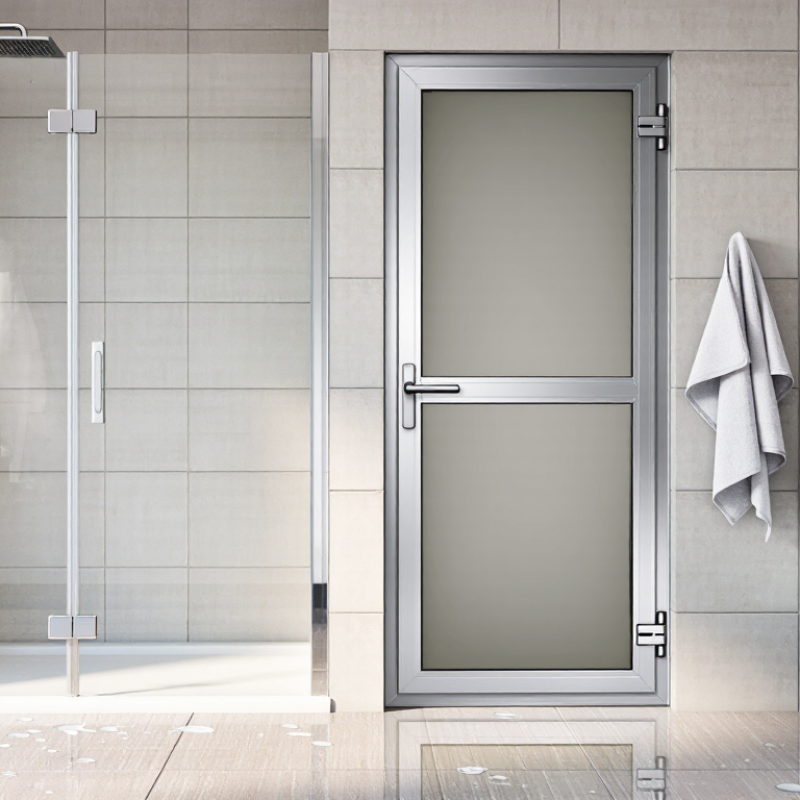
Define Your Bathroom’s Doorway, Layout, and Functional Requirements
Before choosing an aluminum bathroom door, define the doorway rather than the door itself. Measure the finished opening, wall thickness, ceiling height, and nearby fixtures. I once treated the doorway as a finishing detail. That mistake created a narrow passage and awkward contact with the vanity. Small errors matter.
The 2010 ADA Standards specify at least 32 inches of clear opening for an accessible door. Even when accessibility is not mandatory, that dimension provides useful planning guidance. The National Kitchen & Bath Association recommends approximately 30 by 48 inches of clear floor space near bathroom fixtures. Mark this area with painter’s tape before selecting a swing door. A sliding aluminum door may protect circulation, but it needs reliable rollers and enough wall length. A hinged door may seal better, yet its swing can block a toilet or cabinet. That assumption fails in compact layouts.
The U.S. Environmental Protection Agency reports that bathroom ventilation should remove moisture effectively, so the doorway should not obstruct airflow. Select corrosion-resistant aluminum, smooth surfaces, and hardware that tolerates daily condensation. Check the threshold carefully. A raised threshold can reduce water escape, but it can also create a trip point. Frosted or textured glass improves privacy, while clear panels make a small room feel larger. I would also test the handle with wet hands. Specifications rarely reveal that practical weakness.
7 Tips for Choosing an Aluminum Bathroom Door - Define Your Bathroom’s Doorway, Layout, and Functional Requirements
| No. | Selection Tip | Key Dimension or Requirement | Practical Guidance | Why It Matters | Pre-Installation Check |
|---|---|---|---|---|---|
| 1 | Measure the Doorway Accurately | Record the rough opening, finished opening, wall thickness, height, and available trim space. | Measure width at the top, middle, and bottom, then measure height on both sides. Use the smallest measurement when checking product fit. | Bathrooms often have tiled or uneven surfaces, so a small measurement error can prevent the frame from sitting square. | Confirm the opening is plumb, level, and large enough for the selected frame and required installation tolerances. |
| 2 | Choose the Right Door Layout | Compare hinged, sliding, folding, and pocket-door configurations according to the available clearance. | Use a hinged door when there is clear swing space. Consider sliding or folding hardware where fixtures, cabinets, or narrow corridors restrict the swing. | The opening direction affects circulation, privacy, emergency access, and the usable floor area inside the bathroom. | Mark the full swing arc or sliding track on the floor and verify that it does not conflict with a toilet, vanity, shower, or towel rail. |
| 3 | Check Clear Opening and Accessibility | For an accessible route in the United States, a door generally needs at least 32 inches (815 mm) of clear opening when open to 90 degrees. | Allow for the frame, hinges, seals, and hardware when calculating clear width. Keep thresholds low and beveled where accessibility is required. | A wide, unobstructed opening improves wheelchair, walker, and child access and makes daily use more comfortable. | Verify local building and accessibility requirements before finalizing the door size, swing, and threshold detail. |
| 4 | Select a Moisture-Resistant Aluminum System | Prioritize corrosion-resistant aluminum profiles, sealed joints, and finishes suitable for humid interior environments. | Choose a durable powder-coated or anodized finish and use compatible fasteners. Avoid designs that allow water to remain trapped in the frame. | Bathrooms experience frequent condensation, splashes, and cleaning chemicals that can damage poorly protected metals and hardware. | Inspect drainage paths, corner joints, sealant compatibility, and the manufacturer’s care instructions for the selected finish. |
| 5 | Match the Infill to Safety and Privacy Needs | Choose opaque panels, frosted glazing, textured glazing, or safety glass according to the door location and privacy level. | Where glass is used near a wet area, specify safety glazing that is suitable for doors and impact-prone locations, subject to local code requirements. | The infill controls visibility, daylight, cleaning effort, and the consequences of accidental impact. | Confirm privacy from nearby bedrooms or hallways, check panel edges, and verify that the glazing marking and documentation meet local regulations. |
| 6 | Evaluate Ventilation, Sealing, and Water Control | Balance privacy and airflow while keeping splash water away from adjacent floors and walls. | Use suitable perimeter seals or a bottom sweep where needed, but do not block required ventilation. Coordinate the door with the bathroom exhaust strategy. | Effective moisture control helps reduce condensation, odors, mold growth, and deterioration of nearby finishes. | Check the location of exhaust fans, air-transfer paths, floor slopes, shower spray zones, and any required gap beneath the door. |
| 7 | Review Hardware, Maintenance, and Long-Term Use | Assess hinge capacity, handle position, lock function, adjustment range, cleaning access, and replacement-part availability. | Select smooth-operating hardware with surfaces that are easy to clean. Avoid sharp projections and confirm that the door can be adjusted after installation. | Reliable hardware improves safety, privacy, usability, and service life, especially in a frequently used humid space. | Test the door under its final weight, check latching without excessive force, and keep installation and care documentation for future maintenance. |
FAQS
Measure the finished opening, wall thickness, ceiling height, and nearby fixtures. Measure the opening at several points. Walls may be uneven. Measure twice.
Sliding doors protect floor space and circulation. They need enough wall length and reliable rollers. Hinged doors can seal better, but their swing may hit a toilet or vanity. There is no perfect choice.
Aim for at least 32 inches of clear opening when accessibility matters. Keep about 30 by 48 inches of clear floor space near fixtures. Mark the area with painter’s tape before ordering.
Look for corrosion-resistant aluminum, sealed joints, and smooth surfaces. A commonly used extrusion alloy is 6063 aluminum. Ask for the actual alloy specification. “Premium” alone proves little.
Anodizing forms protection within the aluminum surface and usually resists peeling. Powder coating offers more colors and a thicker finish. Inspect corners, drilled holes, and bottom rails for weak spots.
Choose sealed joints, drainage paths, and corrosion-resistant screws. Stainless hardware can help. However, incompatible metals may still create galvanic corrosion. Coastal air is harsh.
Frosted or textured glass hides silhouettes and still allows some light. Clear glass makes a small room feel larger. Heavy obscuring may make a dark bathroom feel gloomy.
Test hinges, handles, rollers, and seals with wet hands. They should feel firm and operate smoothly. Check whether their edges allow easy cleaning. I once trusted specifications too much; practical testing revealed the weakness.
Request a physical sample and inspect it under bathroom lighting. Check color, coating thickness, corners, and surface defects. Photographs can hide flaws. A sample cannot reveal everything, but it helps.
Conclusion
Choosing the right Aluminum Bathroom Door begins with understanding your bathroom’s doorway, available space, traffic flow, and practical needs. Measure the opening carefully and consider whether a hinged, sliding, or folding design will work best. Compare aluminum grades, protective coatings, and corrosion resistance to ensure the door can handle humidity and frequent use. You should also select suitable glass, hardware, and privacy features, such as frosted panels, secure locks, and smooth, durable hinges.
Installation quality is equally important. Evaluate whether the door can be installed securely by professionals or with a suitable installation system, and check for safety features that reduce the risk of breakage or injury. Finally, look beyond the initial price by considering cleaning requirements, expected service life, warranty coverage, and the supplier’s reliability. A well-chosen Aluminum Bathroom Door should provide dependable performance, attractive design, easy maintenance, and good long-term value within your budget.