Acoustic & Thermal
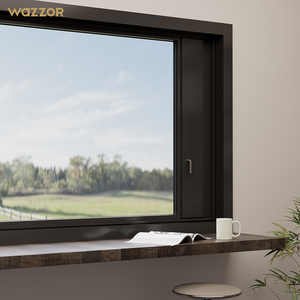
Engineered for maximum airtightness, acoustic dampening, and tropical storm resistance. Explore our factory-direct CE compliant awning and specialty systems.
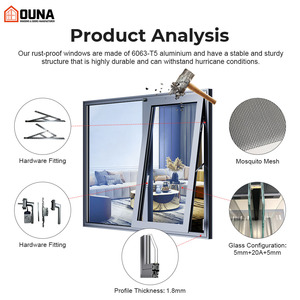
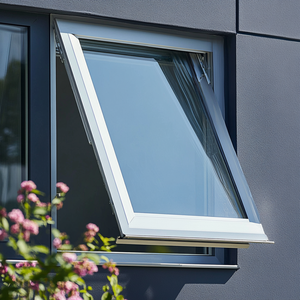
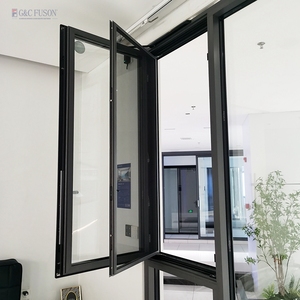
In-depth architectural analysis covering structural load tolerance, thermal barrier integration, and micro-ventilation rain protection algorithms.
Aluminum awning windows hinge at the top and swing outward from the base, creating a friction-balanced overhang. When wind-driven rains pound external envelopes, the physical awning acts as a water deflector while air escapes via controlled pressure equalization chambers. Equipped with triple-fin EPDM vulcanized co-extruded gaskets, our frames exceed EN 12208 Class 9A waterproof benchmarks, holding back over 600 Pa dynamic water immersion.
Tropical and sub-zero climates alike suffer from thermal bridging in uninsulated extruded profiles. Our systems utilize 24mm to 34mm technoform Polyamide PA66 reinforced with 25% glass fiber (GF25). This ensures profile expansion coefficients match 6063-T6 aluminum alloys perfectly, completely preventing seal shearing, interior condensation sweating, and achieving U-values as low as 1.1 W/(m²·K) when paired with Low-E argon insulated units.
Traditional sash locks create isolated perimeter seal pressure, leading to peripheral air leakage. DERCHI awning systems integrate German Sobinco or Siegenia stainless-steel concealed drive rods connected to peripheral cam-locks. When the 360-degree zinc-alloy chain winder pulls the sash shut, the cam pins simultaneously draw the frame tight against the multi-lip sealing rubbers with over 450N of perimeter clamping force.
| Performance Standard | Test Methodology | DERCHI Engineering Specification | Architectural Impact |
|---|---|---|---|
| Structural Wind Load | EN 12211 / AS 2047 | Class C5 / N6 Rating (≥ 4500 Pa Design Pressure) | Withstands typhoon cat 5 coastal gales without sash dislodgement. |
| Air Permeability | EN 12207 / ASTM E283 | Class 4 (≤ 0.15 m³/(h·m) @ 100 Pa) | Eliminates envelope drafts, dramatically reducing HVAC loads. |
| Watertightness | EN 12208 / AS 4420.5 | Class E1050 (Zero penetration up to 1050 Pa static) | Maintains ventilation in severe monsoons; zero interior water leak. |
| Acoustic Attenuation | ISO 10140-2 / ASTM E90 | Rw = 42 dB to 48 dB (with acoustic laminated IGU) | Isolates high-frequency traffic and tropical downpour clatter. |
| Thermal Transmittance | ISO 10077-2 / NFRC 100 | U-value: 1.1 – 1.6 W/(m²·K) (Configuration Dependent) | Complies with European Passive House and Green Mark certifications. |
B2B developers, general contractors, and facade consultants must navigate changing regional statutory demands. Here are the core forces transforming global awning window specifications.
Global procurement is shifting toward low-carbon aluminum. Buyers now demand certified prime billets extruded using hydropower or secondary post-consumer scrap (< 4.0 kg CO2e/kg Al) compliant with EU CBAM (Carbon Border Adjustment Mechanism) directives.
Smart building automation (BMS) integration is surging. Procurement contracts now mandate hidden 24V DC electromechanical chain winders wired to wind, rain, and CO2 sensors for decentralized passive night-cooling purging systems.
To eliminate on-site labor variances and weather delays, developers demand factory-glazed, fully assembled awning units packaged with integrated structural fixing sub-frames, minimizing installation errors across high-rise coastal facades.
Coastal developments require divergent aesthetics: warm fluorocarbon wood-grain textures inside, coupled with Qualicoat Seaside Class 3 super-durable powder coating or 25-micron hard-anodized exteriors to withstand aggressive airborne chlorides.
Operating under the global industrial flag of DERCHI, our enterprise is ranked among the Top 10 premium architectural door and window manufacturers in China. For over 25 years, our specialized facility in Foshan, Guangdong has engineered and fabricated high-precision aluminum envelope solutions for luxury residences, commercial complexes, and hospitality landmarks worldwide.
From custom structural wind-load simulations to bespoke extrusion profile dies, DERCHI provides an integrated supply chain: precision extrusion, CNC multi-axis milling, automated glass insulating lines, and full-scale mock-up testing chambers. We eliminate project friction by aligning direct manufacturing timelines with international shipping demands.

Direct technical answers addressing structural engineering, sea-freight logistics, certification validation, and architectural customization.
CE marking confirms that our aluminum awning windows have undergone rigorous Third-Party Notified Body factory production control (FPC) and Type Testing. It validates measurable thresholds for air permeability (EN 12207), watertightness (EN 12208), wind resistance (EN 12211), and acoustic performance, ensuring that architects and general contractors clear local building control audits without liability.
Awning windows are top-hinged and open outward from the bottom, creating a natural protective glass roof over the opening. This allows 24/7 passive ventilation even during severe monsoon rains. Furthermore, horizontal wind-load vectors press the top sash tighter against the frame's head jamb, improving negative-pressure gasket sealing compared to side-hung casements.
AS 2047 is the stringent Australian standard for external windows in buildings. An "N6" rating represents the highest non-cyclonic and cyclonic category testing, requiring windows to endure ultimate design gust pressures exceeding 4500 Pascals and water pressure tests at over 450 Pascals without failure. This validates exceptional mechanical durability for typhoon belts across the Philippines, Vietnam, Florida, and the Pacific.
Yes. Our impact-rated awning windows feature multi-layer laminated architectural glass assemblies comprising heat-strengthened or fully tempered glass fused with SentryGlas (SGP) or high-tensile PVB interlayers (e.g., 6mm Low-E + 12A Argon + 6mm Clear + 1.52SGP + 6mm Clear). These assemblies withstand direct structural debris impacts and cyclic fatigue loads.
For installations within 500 meters of the ocean, we recommend either Qualicoat Seaside Class 3 fluorocarbon (PVDF) 3-coat spray coating (minimum 70% Kynar 500 resin) or 25-micron architectural anodizing. These surface finishes successfully pass 3,000-hour accelerated neutral salt spray (AASS) tests without blistering, pitting, or chalking.
All fenestration systems undergo a 5-tier packaging protocol: (1) protective PE low-tack protective tape on all aluminum extrusions, (2) shock-absorbing bubble wrap, (3) corner edge protectors, (4) heavy-duty cardboard wrap, and (5) fully enclosed fumigated plywood crates (ISPM 15 certified) with desiccants to counter container condensation cycles.