Curated Tilt & Turn Fenestration Systems
Tested and certified to North American NFRC/AAMA, Australian AS 2047 N6, and European CE standards. Every architectural system below features precision thermal-barrier extrusion and multi-point perimeter gasket locking.
The Mechanics of Precision Tilt & Turn Fenestration
Why commercial builders, facade consultants, and institutional developers are shifting procurement specifications from legacy sliding or top-hung casements to inward tilt-and-turn envelope systems.
Kinematic Geometry & Perimeter Gasket Compression
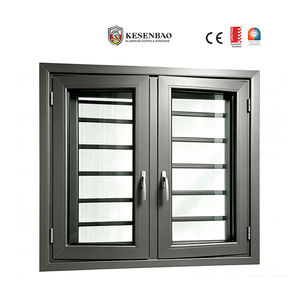
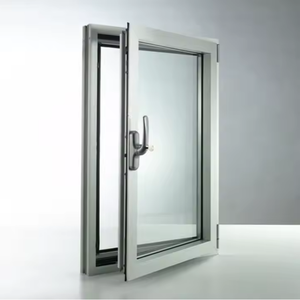
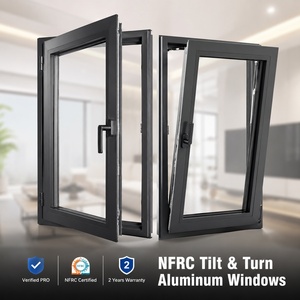
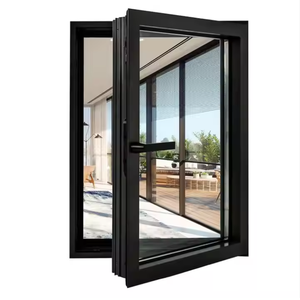
Unlike standard outward casements or horizontal sliding systems that rely on sliding brush seals, an industrial-grade aluminium tilt and turn window utilizes a continuous vulcanized EPDM compression gasket array around the entire sash perimeter. When actuated by the ergonomic single-handle system, heavy-duty internal gearboxes drive mushroom-head locking cams into hardened steel strike keepers positioned strategically along all four interior frame channels.
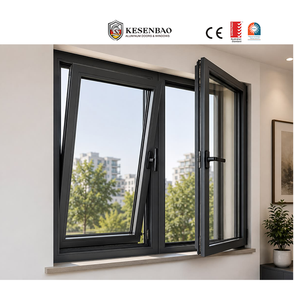
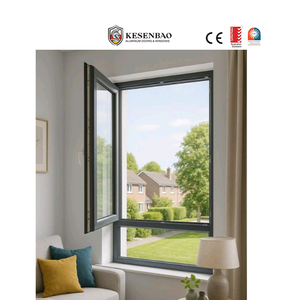
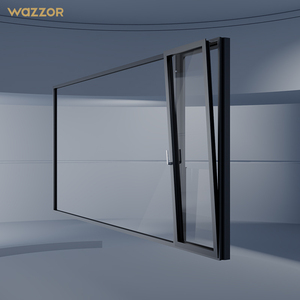
In the tilt position (typically handle at 180° vertical rotation), the upper sash articulates inward by 10° to 15°, utilizing bottom scissor stays to deliver draft-free convective ventilation. Rainwater is mechanically repelled by exterior drip profiles, while negative interior pressure draws stale air out through the top gap without letting wind-driven rain penetrate. In the turn position (handle horizontal at 90°), the sash swings inward 90° to 180° on heavy-duty corner pivot hinges, facilitating 100% egress clearance and effortless ground-level cleaning access for high-rise elevations.
Thermal Metallurgical Optimization: PA66GF25 Barrier Physics
Aluminum profiles exhibit high thermal conductivity ($k \approx 160-200 \text{ W/m}\cdot\text{K}$). To meet contemporary energy conservation mandates across North America and Europe, Chinese tier-1 extrusion factories integrate advanced polyamide thermal isolators. Extruded architectural sections are split into interior and exterior chambers, knurled mechanically, and crimped under calibrated roller tension with PA66-GF25 (polyamide 66 reinforced with 25% structural glass fibre).
This glass-filled composite exhibits a coefficient of thermal expansion nearly identical to architectural aluminium alloy 6063-T5 ($\alpha \approx 2.3 \times 10^{-5}/\text{K}$), preventing delamination, thermal fatigue cracking, and structural shearing under cyclical temperature differentials spanning $-40^\circ\text{C}$ to $+80^\circ\text{C}$. Iso-bar chamber cavities are further packed with high-density polyolefin or aerogel insulation strips, attenuating radiative heat transfer across the frame profile to achieve thermal transmittance values down to $U_f \le 1.1 \text{ W/m}²\text{K}$.
Engineering Performance Benchmarks: System Comparison
| Performance Indicator | Aluminium Tilt & Turn (Thermal Break) | Traditional Aluminum Sliding | Standard Outward Casement | uPVC European Tilt & Turn |
|---|---|---|---|---|
| Thermal Transmittance ($U_w$) | 0.80 – 1.30 W/m²K (Superior) | 2.20 – 3.80 W/m²K (Poor) | 1.40 – 2.10 W/m²K (Moderate) | 0.85 – 1.25 W/m²K (High) |
| Air Infiltration (ASTM E283) | < 0.05 cfm/ft² (Hermetic) | 0.20 – 0.35 cfm/ft² (High bypass) | 0.08 – 0.15 cfm/ft² (Good) | < 0.05 cfm/ft² (Hermetic) |
| Water Tightness (ASTM E331/E547) | 700 – 1200 Pa (No Leakage) | 150 – 300 Pa (Prone to spillover) | 450 – 700 Pa (Moderate) | 600 – 900 Pa (Good) |
| Structural Wind Load (AS 2047 / E330) | N6 Rating / ≥ 5000 Pa (Severe) | N2 – N3 / ~1500 Pa (Low) | N4 – N5 / ~3000 Pa (Medium) | N3 – N4 (Subject to thermal sag) |
| Acoustic Isolation (STC / Rw) | STC 38 – 45 dB (Acoustic laminate) | STC 25 – 30 dB (Air leaks) | STC 32 – 36 dB (Moderate) | STC 35 – 40 dB (Good) |
| Max Sash Weight / Span Capability | Up to 300 kg / High-rise facades | 120 kg / Track wear limitation | 80 kg / Friction hinge sag risk | 130 kg / Steel reinforcement creep |
Global Sourcing Dynamics & Purchasing Trends (2025–2030)
A macro-economic analysis of global building materials procurement, factory-direct purchasing models, and total landed cost optimization for fenestration imports from South China.
Total Landed Cost vs. Local Sourcing
While domestic European or North American fabricators charge between $450 and $850 per square meter for premium tilt-and-turn units, direct Tier-1 Foshan factory sourcing achieves equivalent technical parameters at $140 to $260 per square meter FOB. Even when accounting for international 40HQ ocean freight, port handling tariffs, and custom crating, tier-1 developers routinely capture 38% to 55% net capex reductions across commercial multi-family and master-planned villa developments.
Decoupling via Standard Certification
Historically, importing architectural fenestration faced regulatory bottlenecks during building inspector plan sign-offs. Modern China Tier-1 suppliers have bypassed this friction by pre-certifying standard system dies under recognized mutual recognition arrangements (MRAs). Systems carry full testing dossiers under AS 2047 N6 (Australia), NFRC 100/200/500 (USA), CSA A440 (Canada), and CE EN 14351-1 (Europe), guaranteeing rapid municipal permit clearance.
Low-Carbon Aluminium & CBAM Preparedness
With the European Union Carbon Border Adjustment Mechanism (CBAM) entering full fiscal execution, procurement managers are prioritizing factories utilizing certified green hydro-powered aluminium billets. Our Foshan supply chain deploys circular scrap recycling loops and traceable smelting certificates, ensuring low embodied carbon footprints (< 4.0 kg CO₂e per kg aluminium) that comply with cross-border ESG audits.
Architectural & Technology Trends Reshaping Tilt & Turn Windows
From smart building envelope automation to extreme climate resilience, explore the innovations dominating architectural schedules for 2026 and beyond.
Ultra-Narrow Visual Profiles (Minimalist Sightlines)
Modern luxury architecture demands maximum daylight penetration and invisible frame mass. Contemporary tilt-and-turn engineering replaces bulky 80mm face profiles with narrow sightlines down to 45mm – 50mm without sacrificing moment of inertia. Frame profiles employ concealed sash technology (where the operable sash frame is completely nested behind the outer frame rebate), delivering a continuous flush glass appearance externally.
Smart IoT Micro-Ventilation & Concealed Actuators
High-end residential developments are integrating motorized multi-point gearboxes directly inside the euro-groove chamber. Interfaced with building management systems (BMS) or smart home protocols (Zigbee/KNX/Matter), windows automatically trigger a micro-tilt stroke of 15mm when indoor CO₂ or humidity thresholds rise, sealing instantly upon detecting precipitation via external capacitive rain sensors.
Electrochromic & Photovoltaic BIPV Glazing Units
Commercial facades are moving beyond passive low-emissivity coatings to dynamic solar control. Double and triple IGUs now incorporate electrochromic smart glass that transitions from clear to tinted under low-voltage stimulation, slashing cooling HVAC operational loads by up to 32%. Simultaneously, transparent photovoltaic coatings embedded inside the outer sacrificial pane harvest daylight to power motorized blinds.
Severe Cyclone & SGP Hurricane Lamination
In response to volatile tropical typhoon tracks in the Pacific Rim, the Caribbean, and Southeast Asia, tilt-and-turn units are integrated with SentryGlas® (SGP) ionoplast interlayers. When tested under Miami-Dade NOA large missile impact protocols (9-pound $2\times4$ timber cannon at 50 ft/s followed by 9,000 cyclic pressure reversals), the mechanical tilt-and-turn multi-point latching prevents frame deflection blowout where typical friction hinges fail catastrophically.

Manufacturing Prowess: Guangdong Dejiyoupin (DERCHI)
Operating out of Foshan, Guangdong—the epicenter of global aluminium extrusion and precision architectural metallurgy—Guangdong Dejiyoupin Doors and Windows Co., Ltd. (DERCHI) represents the pinnacle of Chinese high-performance fenestration manufacturing with over 25 years of specialized operational expertise.
Ranked among the Top 10 premium door and window brands in China, our automated industrial campus houses German five-axis CNC profile machining centers, automated corner crimping stations with two-part polyurethane corner cleat injection, and climate-controlled robotic insulated glass processing lines.
- 180,000 m² Mega Industrial Base: Fully integrated processing lines handling billeting, extrusion, powder coating, assembly, and testing.
- 600+ Skilled Technicians & QA Engineers: Ensuring micron-level dimensional tolerances on corner miters and gasket intersections.
- 100+ Active Patents & Global Certifications: Fully certified under ISO 9001, CE, AS 2047 N6, NFRC, AAMA, and UL Fire-Rated standards.
- Proven Global Project Delivery: Recognized at WORLDBEX 2025 Philippines and trusted across hundreds of residential and commercial developments throughout the USA, Canada, Australia, the Middle East, and Southeast Asia.

Frequently Asked Questions for Wholesale Tilt & Turn Window Sourcing
Authoritative technical, regulatory, and logistics answers for commercial importers, project developers, and architectural procurement directors.
Partner with China's Premier Tilt & Turn Manufacturing Leader
Whether you require custom shop drawings for an architectural luxury villa development or high-volume wholesale pricing for commercial multi-family projects, our engineering team in Foshan delivers comprehensive technical proposals within 24 hours.