Architectural Portfolio
Precision-Engineered Window & Door Assemblies
Explore our export-certified fenestration systems manufactured with precision CNC tolerances, structural thermal breaks, and premium hardware integration.
Industrial Specification Guide
Engineering Hybrid Fenestration: The Mechanics of Clad Systems
A comprehensive analysis of structural composite stability, thermal barrier chemistry, and architectural timber treatments for commercial procurement officers.
In modern architectural envelope engineering, the convergence of sustainable internal finishes and resilient external cladding has positioned composite aluminum-wood fenestration systems as the premier choice for low-energy luxury villas, institutional facilities, and coastal developments. Standard solid-timber profiles inherently battle seasonal volumetric variance, swelling during monsoons and contracting in dry winter climates. Conversely, single-alloy aluminum windows without advanced polymatrix thermal breaks present severe condensation points and poor thermal resistance coefficients.
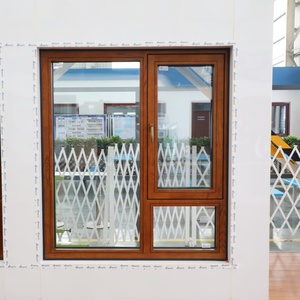
As a verified OEM/ODM aluminum and wood windows supplier, DERCHI addresses this structural dichotomy through an engineered floating connection mechanism. The exterior extruded 6063-T6 aluminum alloy profile absorbs cyclical wind loads, UV bombardment, and high-salinity ambient air, while the interior multi-laminated solid wood component (sourced from sustainably managed North American red oak, European larch, or black walnut) delivers optimal thermal inertia and natural biophilic interior aesthetics. By isolating the disparate expansion coefficients of metal and organic timber using specialized polyamide (PA66 GF25) dynamic clips, our system eliminates internal shear stresses across a -40°C to +80°C operating spectrum.
| Engineering Attribute | Standard Commercial Timber | Standard Thermal Break Aluminum | DERCHI Architectural Alu-Wood Composite |
|---|---|---|---|
| Thermal Transmittance (U-Value) | 1.6 – 2.0 W/m²K | 1.8 – 2.4 W/m²K | 0.79 – 1.20 W/m²K (Passivhaus Compliant) |
| Acoustic Attenuation (Rw / STC) | Rw 30 - 34 dB | Rw 32 - 36 dB | Rw 42 - 48 dB (Triple Laminated Acoustic Glazing) |
| Cyclic Structural Integrity | Prone to warp, rot & termite impact | Rigid, risk of thermal bridging | Zero warping; isolated expansion via PA66 snap joints |
| Wind Load Resistance | Class 3 (1200 Pa) | Class 6 (3000 Pa) | AS 2047 N6 Certified (> 4500 Pa extreme typhoon spec) |
| Water Penetration Resistance | 300 Pa (Prone to joint capillary leaks) | 450 Pa (Gasket dependent) | EPDM Multi-Chamber Continuous Gasket (> 700 Pa) |
Our OEM/ODM manufacturing protocols enforce precision timber moisture modulation through a computerized multi-stage vacuum drying process, stabilizing lumber internal relative humidity precisely between 8% and 12%. Exterior aluminum extrusions undergo fluorocarbon PVDF electrostatic spraying or marine-grade anodizing exceeding Qualicoat Class 2 standards, ensuring that high solar ultraviolet radiation in Southeast Asia or coastal salt spray in the Pacific basin causes negligible color degradation over a 30-year lifecycle.
Strategic Procurement
Emerging Trends in Global Architectural Fenestration Sourcing
Critical market shifts and supply chain dynamics influencing specification patterns across North America, Europe, Australia, and ASEAN developers.
Passive House & Carbon Neutrality
Global building codes, including European EPBD revisions and California Title 24, now require assemblies to achieve whole-window U-factors below 0.8 W/m²K. Buyers are migrating en masse toward triple-pane Krypton/Argon insulated glass units combined with warm-edge composite spacers.
Prefabricated Unitized Systems
On-site labor shortages and compressed construction schedules are pushing procurement towards fully assembled, pre-glazed window-wall units. Contractors demand complete pre-calibrated multi-point hardware assemblies ready for crane-assisted direct installation into building envelopes.
Extreme Meteorological Resilience
With erratic climate events, international specifications now mandate cross-compliance with AS 2047 (cyclone testing) and Florida Miami-Dade hurricane impact standards. Procurement teams demand physical cyclic air pressure and large-missile projectile impact certification data.
R&D Innovation
Evolutionary Vectors in Aluminum-Wood Technologies
How cutting-edge material science, smart home protocol integration, and automation are defining the next generation of window systems.
Slim Sightline Minimalist Profiles
Architectural demand has transitioned from bulky classical joinery to ultra-narrow frames with concealed sashes and fully hidden hinges. Engineering structural strength into a 45mm visible face demands aeronautical-grade alloy extrusions and high-modulus structural silicone bonding.
Electrochromic & Photovoltaic Glass
The integration of dynamic tinting (BIPV / smart switchable glass) directly into the insulated glazing unit allows computerized solar heat gain coefficient (SHGC) modulation, interacting seamlessly with central building management systems via KNX or Zigbee architectures.
Bio-Polymer Modified Lumber
To eliminate petroleum-based preservation chemicals, modern OEM suppliers are adopting furfurylation and thermal modification technologies. This processes raw timber through an organic biological polymer bath, rendering the wood inert to cellular moisture reabsorption and biological decay.
180,000㎡
Industrial Production Base
600+
Specialized Engineers & Techs
100+
Global Patents & Testing Certs
25+
Years Dedicated Fenestration Focus
Factory-Direct Capacity
Guangdong Dejiyoupin Doors and Windows Co., Ltd. (DERCHI)
Headquartered in Foshan, Guangdong—the worldwide epicenter of precision architectural metalworking—DERCHI stands as a Top 10 manufacturer recognized across China, North America, Oceania, and Southeast Asia.
Our expansive 180,000 m² smart manufacturing ecosystem integrates automated European CNC milling centers, cleanroom glass lamination corridors, and robotic electrostatic coating lines. Backed by 25+ years of engineering rigor, we deliver comprehensive OEM/ODM custom solutions tailored to rigid structural criteria, international fire codes, and strict architectural milestones.
From custom oversized monumental pivot entry doors to passive-house certified aluminum-clad wood windows, our systems carry full validation under CE, ISO 9001, AS 2047 N6, and UL standards, having powered milestone installations showcased at global conventions including WORLDBEX 2025.
- In-House 3D CAD/BIM Detailing
- Complete Structural Testing Laboratory
- Direct Oceanic Project Containerization
- English Technical Engineering Team

Procurement Knowledge Base
Frequently Asked Questions for Project Specifiers
Technical clarity on thermal performance, custom engineering, logistics, and quality assurance workflows.
How does DERCHI prevent differential thermal expansion between wood and aluminum?
We do not adhere or rigidly screw aluminum directly to lumber. Instead, we utilize high-tensile glass-fiber-reinforced polyamide nylon clips (PA66 GF25) positioned at engineered centers. This permits independent micro-axial sliding movement while transferring external wind pressure solidly into the structural timber sash without generating warping or surface puckering.
What timber species are available for OEM interior profiles, and how are they protected?
Our standard procurement includes FAS-grade American Red Oak, Russian Larch, White Oak, and North American Walnut. The timber profiles are multi-laminated to relieve longitudinal tension, conditioned to an 8%–12% equilibrium moisture content, and finished with eco-friendly European waterborne polyurethane coatings that protect against mold, termites, and fungal degradation while maintaining micro-porous breathability.
Can you manufacture fenestrations matching specific cyclonic or hurricane codes?
Yes. Our window systems are rigorously tested and certified under AS 2047 N6—the benchmark for Australian cyclone zones—handling ultimate design gust pressures exceeding 4500 Pascals. For hurricane coastal zones, we integrate multi-layer PVB or SentryGlas (SGP) laminated glass configurations with reinforced structural framing anchoring brackets.
What is the standard lead time for customized commercial OEM/ODM project batches?
Shop drawings (detailed CAD/BIM submittals) are generated within 48 to 72 hours of receiving architectural schedules. Upon final approval of hardware schedules and color swatches, standard production lead times are typically 25 to 35 calendar days, supported by rigorous factory staging, pre-hanging verification, and export seaworthy crating.