Alloy Metallurgy & Structural Stability
DERCHI implements virgin architectural billet 6063-T5 and 6063-T6 structural grade aluminum, delivering minimum tensile strengths of 205 MPa. Profile wall thicknesses range from 2.0mm to 3.0mm, allowing multi-panel configurations up to 4500mm frame heights without perceptible transom deflection under dynamic cyclone-grade wind loads.
Thermal Barrier & Acoustic Decoupling
Incorporating PA66GF25 polyamide thermal struts (reinforced with 25% short glass fiber), our stacking systems break the conductive path across multi-slide frames. Combined with argon-filled low-E insulated glass units (IGUs) and warm-edge swisspacers, U-values drop below 1.6 W/(m²·K), while sound attenuation achieves up to STC 42 dB.
Heavy-Load Track Kinematics
Each active stacking leaf relies on dual-tandem stainless steel carriage rollers with sealed precision needle bearings. Capable of supporting up to 400 kg per panel, our multi-track thresholds integrate concealed water evacuation weeps, engineered to resist static water pressure up to 700 Pa without internal siphoning.
| Mechanical / Environmental Parameter | Standard Residential Grade | DERCHI High-Span Architectural Stacking System | Primary Test Protocols |
|---|---|---|---|
| Design Wind Load (Ultimate Strength) | 1200 Pa to 1800 Pa | Up to 4500 Pa (AS 2047 N6 / ASTM E330) | AS 2047, ASTM E330 |
| Water Ingress Resistance | 150 Pa – 300 Pa | 600 Pa – 750 Pa (Concealed Sub-Sill Weep Drainage) | EN 12208, AAMA 501.1 |
| Thermal Transmittance (U-Factor) | 3.2 – 4.5 W/(m²·K) | 1.4 – 1.8 W/(m²·K) (Polyamide Barrier + Argon DGU) | NFRC 100/200, ISO 10077-2 |
| Acoustic Isolation Rating | Rw 25 – 28 dB | Rw 38 – 42 dB (Acoustic PVB Laminated Tri-Pane) | ASTM E90, ISO 140-3 |
| Extrusion Anodizing & Coating | 10–15 μm Ordinary Powder | 25 μm Qualicoat Class 3 / 70% Fluorocarbon PVDF | AAMA 2605, ISO 2360 |
Concealed Frameless Profiles
Modern luxury residential and resort design trends demand the elimination of visual boundaries. Future stacking door orders increasingly specify ultra-narrow sightlines (≤ 20mm interlockers) and zero-step flush bottom tracks embedded directly into subflooring with integrated concealed linear gutters.
IoT-Integrated Smart Motorization
Driven by smart building building management systems (BMS), high-mass multi-track stacking doors are transitioning from manual push-pull to brushless magnetic levitation (Maglev) and hidden motor drives. These systems incorporate automated wind-sensor closures, obstacle safety detection, and RS485/KNX protocol interoperability.
Decarbonization & Circular Billets
Global procurement teams in North America, Europe, and Oceania are shifting toward low-carbon recycled aluminum alloys melted using renewable hydropower. DERCHI provides certified Environmental Product Declarations (EPDs), facilitating LEED Platinum and BREEAM Outstanding credits for developers.
180,000㎡ Mega Production Base
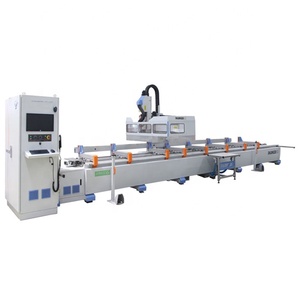
Located in the heart of China’s fenestration cluster in Foshan, Guangdong, our facility operates automated German CNC machining centers, precision multi-angle cut-off saws, automated corner-crimping lines, and continuous electrostatic powder coating tunnels capable of turning around multi-container custom orders within 25–35 days.
Complete Project Shop Drawings
Our 600+ personnel include over 40 structural facade engineers offering end-to-end OEM/ODM design support. We produce free structural calculation sheets, thermal simulation models (THERM), and comprehensive CAD/BIM shop drawings aligned with your architectural door schedule and local structural anchor codes.
Time-Zone Synchronized Support
DERCHI provides dedicated bilingual project management teams working across Southeast Asia, North America, Oceania, and Middle Eastern time zones. From container layout optimization to export-grade fumigated plywood crate packing and on-site remote assembly guidance, our support eliminates risk during turnover.
What is the structural difference between stacking doors and bi-fold doors?
Aluminum stacking doors feature multiple parallel tracks where panels slide and stack behind one another, eliminating interior or exterior projection spaces. Unlike bi-fold systems that hang suspended from top tracks and flex under heavy loads, stacking doors distribute weight onto heavy-duty bottom tracks, making them structurally superior for ultra-wide spans, cyclone zones, and oversized glass panels up to 400 kg each.
Can DERCHI systems be customized for cyclonic or coastal high-salinity areas?
Yes. For coastal applications (e.g., Southeast Asia, Florida, Caribbean, Australia), profiles are treated with 25–30 μm architectural anodizing or Class 3 PVDF fluorocarbon coatings resisting 3,000+ hours of continuous salt spray testing. Fasteners and rolling hardware use marine-grade SUS316 stainless steel, and structural glass can be engineered with SentryGlas (SGP) ionoplast interlayers to pass AS 2047 N6 and NOA impact criteria.
What are the minimum ordering quantities (MOQ) and production lead times?
For custom OEM/ODM architectural projects, our typical MOQ starts at 50 square meters or a combined mixed container load. Standard production lead time is 25 to 35 business days following CAD shop drawing approval and color chip confirmation. Urgent commercial phase orders can be expedited through dedicated CNC scheduling.
Do you supply assembled units or knock-down (KD) packaging?
We accommodate both logistical approaches based on project requirements. Pre-assembled configurations are fully factory glazed, aligned, and hardware-fitted for immediate crane hoisting on site. For high-volume overseas sea container optimization, we provide precision knock-down (KD) kits with labeled pre-machined extrusions, corner cleats, and pre-cut EPDM gaskets to reduce freight volume by over 60%.