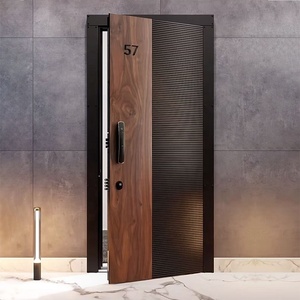
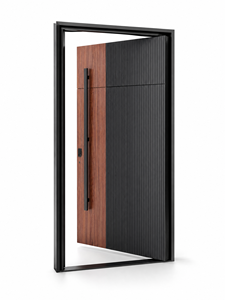
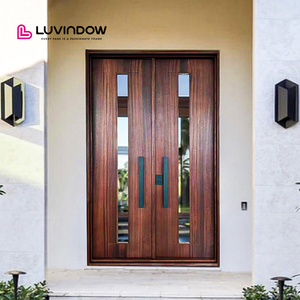
Technical White Paper: Engineering & Sourcing Architectural Aluminum with Glass Doors
In contemporary commercial architecture, high-end hospitality, and luxury multi-residential developments, aluminum glass doors serve as the structural nexus between environmental insulation and spatial aesthetics. Sourcing from a certified OEM/ODM aluminum with glass door exporter requires an intricate understanding of alloy metallurgy, thermal performance physics, glazing composite resilience, and mechanical cycle ratings. As building energy codes intensify under ASHRAE 90.1, EN 14351-1, and Australia’s AS 2047, fenestration cannot merely be viewed as decorative infill; it is an engineered facade envelope component that directly impacts heating and cooling loads, indoor air quality (IAQ), structural safety, and life safety compliance.
Critical Sourcing Benchmark: For tier-1 procurement, structural extrusions must utilize primary virgin billet (AL6063-T5 or AL6063-T6), eliminating scrap contamination to ensure structural deflection limits under extreme wind pressures (e.g., AS 2047 N6 cycle pressure exceeding 4,500 Pa) without frame fracture or air leakage failure.
1. Structural Extrusion Metallurgy: 6063-T5 vs. 6063-T6 Marine Grade Precision
The core structural integrity of exterior aluminum glass swing, pivot, and sliding doors depends heavily on aluminum extrusion chemistry. At our 180,000 ㎡ manufacturing complex in Foshan, Guangdong (Dejiyoupin / DERCHI), architectural profiles are extruded from high-purity 6063-T5 and T6 tempering states. Wall thicknesses range from 2.0 mm for standard sliding systems to 3.5 mm for oversized monumental pivot entry doors. Using high tensile strength alloy guarantees ultimate yield strengths above 160 MPa, effectively handling the excessive dead-weight loads imposed by triple-laminated low-E insulated glass units (IGUs) that can easily exceed 280 kg per operable leaf.
Surface treatments represent another key performance differentiator. Where coastal projects (such as luxury seaside resorts in the Philippines, Indonesia, Florida, or the Caribbean) encounter airborne sodium chloride and sulfur compounds, DERCHI employs automated vertical powder coating lines certified to Qualicoat Class 2 and AAMA 2605 fluorocarbon (PVDF) standards. This electrostatically applied 3-coat/2-bake fluorocarbon finish with a minimum 70% Kynar 500 resin ensures over 20 years of gloss retention, chalking resistance, and an impenetrable barrier against galvanic corrosion.
2. Polyamide PA66GF25 Thermal Barriers & Acoustic Engineering
Uninsulated aluminum frames conduct heat rapidly (high U-value), causing thermal bridging, moisture condensation, and elevated energy dissipation in air-conditioned environments. Modern OEM/ODM manufacturing mitigates this by crimping structural polyamide thermal strips (PA66GF25 reinforced with 25% chopped glass fiber) between interior and exterior aluminum profiles. This creates a complete thermal barrier that matches the thermal expansion coefficient of aluminum, preventing mechanical shearing during seasonal temperature differentials between +45°C exterior sun exposure and +20°C air-conditioned interiors.
When combined with warm-edge composite spacers (such as Technoform or Swisspacer) and argon gas infill, our systems attain thermal transmittance metrics as low as Uw ≤ 1.3 W/(m²·K). For urban hotel developments and luxury condominiums in dense metropolitan hubs (e.g., Manila, Singapore, Bangkok, Vancouver, and London), multi-chamber profiles combined with asymmetric acoustic laminated glass (e.g., 6mm Low-E + 12Ar + 4mm + 0.76mm acoustic PVB + 4mm clear) drop acoustic ingress across the 100–4000 Hz human hearing spectrum by up to Rw = 42 dB, completely muffling urban arterial noise.
3. Performance Matrix: Material & Glazing Specification Cross-Reference
Procurement directors and facade consultants should align door schedules with verified laboratory testing data. The table below delineates engineering baselines across DERCHI's four flagship entrance configurations:
| System Configuration | Profile Wall Thickness | Glazing Specification | Structural Load (Wind) | Thermal U-Value (Uw) | Acoustic Rating (Rw) |
|---|---|---|---|---|---|
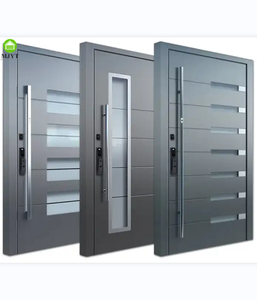
| Monumental Pivot Door | 3.0 mm – 3.5 mm AL6063-T6 | 10mm Tempered + 12Ar + 10mm Lam | AS 2047 N6 (Up to 5,000 Pa) | 1.4 – 1.8 W/(m²·K) | 38 – 42 dB |
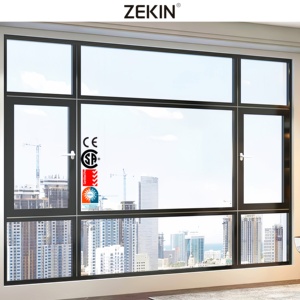
| Thermal Break Casement / French | 2.0 mm – 2.5 mm AL6063-T5 | 6mm Low-E + 16Ar + 6mm Tempered | Florida TAS 202 (3,600 Pa) | 1.2 – 1.5 W/(m²·K) | 36 – 40 dB |
| Cast Aluminum Villa Door with Glass | 2.5 mm Base + 8.0 mm Cast Infill | Double-pane laminated security | Heavy-Duty Security Level RC3 | 1.6 – 2.0 W/(m²·K) | 35 – 39 dB |
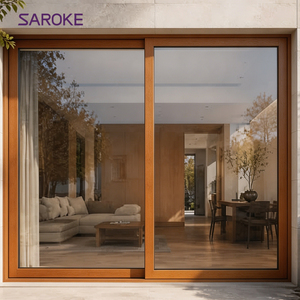
| Ultra-Slim Sliding System | 2.2 mm – 2.8 mm AL6063-T5 | 8mm Low-E + 12Ar + 8mm Tempered | Cyclonic Rating N5 (3,000 Pa) | 1.3 – 1.6 W/(m²·K) | 34 – 38 dB |
4. Glazing Safety, Hurricane Impact & Multi-Point Security Mechanics
Glazing units mounted into our custom doors are fabricated in full compliance with EN 12150 (thermal toughening) and ASTM C1172 (laminated architectural glass). For hurricane zones in North America, East Asia, and the Caribbean, doors integrate heavy-duty interlayers like SentryGlas® (SG ionoplast) or structural PVB (0.76mm to 1.52mm thickness). Even if cyclical flying debris fractures the outer glass lite during severe typhoons, the ionoplast structural interlayer remains taut within the deep structural glazing pocket, preventing pressurization ruptures within the structural building shell.
Security hardware engineering is synchronized with structural profile extrusion. DERCHI incorporates German hardware suites (Siegenia, Roto, GU) alongside custom proprietary CNC-machined components featuring stainless steel 304/316 multipoint perimeter locks. Multi-point mushroom cam bolts lock simultaneously into the reinforced door jamb at 5 to 7 key anchor positions. For high-profile hospitality and private estates, electronic biometric locks, hidden RFID antennas, and commercial motorized deadbolts seamlessly dock into smart building automation (BMS) systems via concealed cabling conduits through the pivot hinges.
